
We are an affiliate
We hope you love the featured products! Just so you know, we may collect a share of sales or other compensation from the links on this page, at no extra cost for the buyer. Thank you if you use our links, we really appreciate it!
 Today, we have an abundance of brilliant choices for wedding rings.
We are inundated with different colors, designs and gems.
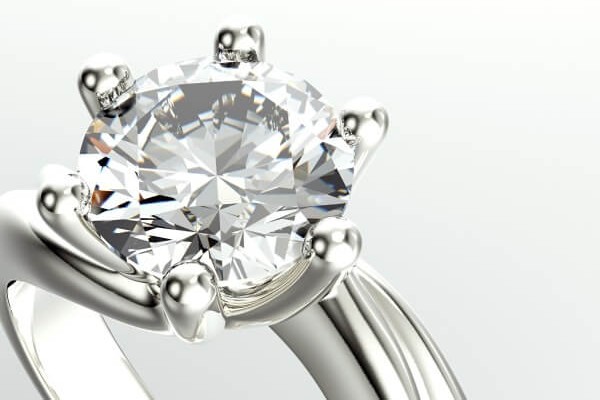
Moissanite is one of these jewels. It is a popular option as a diamond substitute.
- Is moissanite a good diamond alternative?
- How hard is moissanite?
- Does moissanite sparkle like a diamond?
These are probably just three of the questions you have in mind.
And we have the answers.
But let’s handle the first question about its origin:
Is moissanite man made?
The answer is yes and no! Moissanite is a gemstone rarely found in nature. Thankfully, scientists have found ways to produce them in the lab. Today, almost all moissanite jewelry you’ll come across, are man made.
Now, let’s have a closer look to this shiny gem.


Click on the photo to check on Amazon
What is moissanite?
Moissanite is a naturally-occurring gemstone discovered in 1893.
It is not a diamond, sapphire or morganite. They are all different minerals which have similar white appearance. It is a popular option as a colorless diamond substitute like white zircon, white sapphire or white topaz.
The name of this gemstone comes from its discoverer Henri Moissan. This French chemist was inspecting rocks in a meteor crater in Arizona. He took stone samples, which he thought were natural diamonds at the time.
After 10 years, he realized that they had a different structure. The chemical structure of moissanite consists of silicon carbide, not carbon crystals as in natural or lab diamonds.
Today, almost all moissanites are man-made stones as natural moissanite supply can not meet demand. They are widely used in jewelry, electronics and optics for superior light properties.
The production process is cost efficient because it is conducted in controlled environments.
It has minimal impact to environment. This makes moissanite engagement rings affordable environment friendly choice.
As the lab environment enables control, doping the chemical composition with selected materials opens door to many different colored stones.
The selection range from colorless to slight yellow or brown tint. From these, the clear and colorless ones conduct higher prices.
Moissanite stones do not get cloudy because they have a very stable structure. They are very resistant to heat.
They do not include undesired trace minerals like natural gemstones. They are immune from irregularities like fractures and inclusions.
Does moissanite scratch glass?
Moissanite is very hard. It has a high rating on the Mohs scale of mineral hardness.
Glass gets 5.5 on this scale while moissanite is near the top with 9.25.
Thus, it can scratch glass. Only harder materials can scratch these stones.
Moissanite band is a very good choice for daily wear as it is one of the hardest and most durable stone options.
Diamond has the top place with 10. This indicates an extreme level of hardness.
It is very rare that a moissanite jewelry will encounter physical contact with a harder material.


Click on the photo to check on Amazon
Moissanite vs diamond side by side comparison
| Moissanite | Diamond | |
|---|---|---|
| Hardness | 9.25 | 10 |
| Density | 3.21 to 3.22 | 3.5 to 3.53 |
| Dispersion | 0.104 | 0.044 |
| Refractive Index | 2.69 | 2.42 |
What is moissanite fire?
Crystals refract different wave lengths by different angles.
When light enters a crystal, it gets dispersed into different rays of light for each angle.
This dispersion forms a rainbow like view as in the video above.
This is called moissanite fire.
These jewels outperforms even diamond in this aspect.
Why? Because it has a much greater dispersion index than diamond. Thus, when it is subject to a ray of light, the colors will be more separated and more visible.
Brilliance is the ability of the stone to reflect white light or “sparkle.”
While diamonds are brilliant, these simulants may be more so.
Colorwise there is an important difference: Moissanite is not graded by color in the same manner as diamonds.
However, as with diamonds, the smaller the gemstone, the less color it will contain or be visible.
Standard moissanite has a similar color to K-color diamonds.
You may also find nearly colorless jewels.
Moissanites are easier to maintain than diamonds.
They do not have rough edges that attract dirt and grease.
Diamonds are the hardest known mineral on earth, scoring at the top of the scale with a “10”.
Moissanite is close behind with a 9.25 rating that makes it quite hard and durable.
Still, for many people the hardness factor is nearly indistinguishable.
This is the biggest difference between these two stones, based on the classic cut and clarity along with other considerations.
Moissanite costs a fraction compared to diamond.
In the end, if you want diamond engagement ring, that is a matter of personal taste and selection.
While moissanite is not a diamond, it is quite close and makes a great gem.
How to take care of moissanite jewelry
As we have seen above, Moissanite stones are one of the hardest gems with 9.25 on the Mohs Scale. This means very few materials may scratch them.
One of them is diamond which has a greater hardness rating.
Thus, you should not keep your diamond and moissanite jewelry in the same pouch or jewelry box.
Store your jewelry in individual small bags, which will keep from separated from another jewelries.
This way, you can be sure that, when next time comes, they will be ready.
It is very rare that you may encounter with a material hard enough to scratch your moissanite jewelry.
But, that does not mean you should wear them during work like gardening or outdoor activities.
Don’t forget that even many metals are not as hard as moissanite.
For example, gold and sterling have around 3 on the Mohs scale while titanium and rhodium share a solid 6 grade. These metals are softer than natural and man-made moissanite, thus they may get scratched.
Cleaning moissanite jewelry
Dirt and oil may get to your jewelry and diminish its beauty.
In this case, a mild soapy water and a soft cloth should be to enough to clean them up.
Never leave your jewelry wet. Always finish the cleaning by drying them completely.
As usual, make sure gemstones and metals are safe for your cleaning process, especially when using ultrasonic jewelry cleaners.
Never proceed with any cleaning activity before being totally sure that every single part will not be harmed.


Click on the photo to check on Amazon
Conclusion
There are many alternatives to diamonds like white zircon, white sapphire or white topaz.
The members of this list make brilliant gemstones with similar appearances and a more affordable option for engagement rings.
One of these sparkly gemstones is moissanite.
Even though it can be found in nature, nearly every stone we use is lab made.
Just as in natural diamonds vs lab-grown diamonds, these synthetic stones are the same as their natural moissanite cousins.
Thanks to technology, we are able to manage production amount and control cut, color, clarity and carat size of these diamond counterparts.
We can produce inclusion-free gems and also manipulate doping to obtain (nearly) any color we want.
You may want to know if a moissanite is hard as a diamond.
Well, these diamond simulants come very close to in terms of hardness, but diamond has the top score. It has a 10 grade while moissanite is very close with a 9.25 rating.
Rest assured that this is a very high level of hardness. It is higher than surgical grade stainless steel or titanium. Moissanite is a very durable choice which is ready to serve you for a lifetime.
Surprisingly, this brilliant stone outperforms diamond in some areas.
Moissanite is known for its fire which even diamonds can’t match.
Moissanite fire is the rainbow like refraction formation that rays that form. As this brilliant gemstone has a greater refraction index than diamond, its fire is greater too!
If you’d want to know about another popular diamond simulant, you may want to check our post on cubic zirconia vs diamond.