
We are an affiliate
We hope you love the featured products! Just so you know, we may collect a share of sales or other compensation from the links on this page, at no extra cost for the buyer. Thank you if you use our links, we really appreciate it!
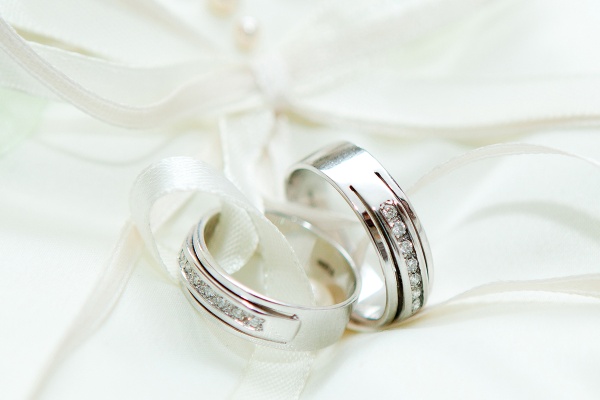 When it comes to wedding rings, there are materials that people often consider. Precious metals gold, silver, platinum and palladium are more or less always receive consideration.
But there are other alternative metals which offer similar silvery white luster in a more durable package.
Three of these strong metals are tungsten, titanium, and stainless steel.
They all have white metallic colors, and you guessed right if you said they are very durable too!
Yet, there is more to the comparison of tungsten vs titanium vs stainless steel rings.
Let’s dive in and check which one is the better option for you!


Click on the photo to check on Amazon
What is tungsten?
Tungsten is a metallic element with the atomic number 74 on the periodic table. It is a relatively new metal that was discovered in the late 18th century.
Its name means “heavy stone” in Swedish, but its abbreviation is not T or Tu. Its symbol is W, short for its other name Wolfram. This latter name comes from the German language meaning “wolf cream”.
It is a silver-white color and is a very dense metal. It has a density of 19.25 g/cm3.
It is found in the form of wolframite and sheelite deposits around the world. Major producers are China, Canada, Russia, Vietnam and Bolivia.
Tungsten has a melting point of 3422 °C or 6192 degrees Fahrenheit.
In the jewelry sector, we mainly concentrate on tungsten carbide, which is a superior form of the strong metal.
Tungsten carbide is a hard, brittle material that is made of equal parts of tungsten and carbon. It is often used to make jewelry because it is very durable and scratch resistant. Tungsten carbide is also used in industrial applications because it has sturdiness and high durability.
Check our post on tantalum vs tungsten rings for a comparison with another tough metal choice.


Click on the photo to check on Amazon
What is titanium?
Titanium is a lustrous, silver-gray metal that is hard, strong, and corrosion-resistant.
Titanium has an atomic number of 22 and a chemical symbol of Ti. It is not radioactive like some plutonium or uranium.
The metal is named for the Titans, the sons of the primordial deity Uranus and the father of Zeus in Greek mythology. Titanium was first isolated in 1825 by English chemist William Hyde Wollaston.
Titanium is the ninth most abundant element in the Earth’s crust.
It occurs in many minerals but is most commonly found in ilmenite and rutile. Main deposits are located in Australia, Canada, China, India, Mozambique, New Zealand, Norway, Sierra Leone, South Africa, and Ukraine.
It has a melting point of 1,668 degrees Celsius or 3,048 degrees Fahrenheit.
Titanium is famous for its high strenght-to-weight ratio. It is not a dense metal. It has a density of only 4.5 grams per cubic centimeter.
Its hardness gets a 6 grade on the Mohs scale. This puts titanium miles further from sterling silver or white gold at the beginning.
Thanks to these distinct qualities of hardness and density, titanium rings and other jewelry are always under spotlight.


Click on the photo to check on Amazon
What is stainless steel?
Stainless steel is not an element like tungsten or titanium. It is the general name of an iron alloy family, which includes many versions. It gets its name from the fact that it does not stain like other metals.
Stainless steel is actually a bluish-white color, but it can be made to look silver by adding more chromium.
Stainless steel is an iron alloy with at least 11% chromium. It may also include other metallic and non-metallic elements to specialize according to a specific use case.
Iron and iron alloys do rust. But stainless steel does not rust or corrode.
The melting point of stainless steel is about 1,500 degrees Celsius (2,700 degrees Fahrenheit).
Steel alloys are used in probably every imaginable sector from automotive industry to machinery, from kitchen appliances to jewelry.
Here, our focus will be on a very specific version: 316L type stainless steel.
This steel alloy is hypoallergenic, meaning it is safe for human tissue. Not every steel is safe for skin sensitivity. This is a crucial point which should get the highest attention. Low quality steel jewelry can cause many problems as we shall see below.
This is an extra low carbon version of 316 type steel which has high resistance to corrosion. It is often used for producing watches, marine applications and all sorts of jewelry.


Click on the photo to check on Amazon
Pros and cons of tungsten vs titanium vs stainless steel rings
1. Color and shine
All three metals have white gray color but with varying levels of luster.
As they can be painted or plated, we’ll stick to their plain versions for comparing color and shine.
Tungsten carbide will have the closest appearance to a sterling silver or rhodium plated white gold.
Titanium and stainless steel rings will follow respectively.


Click on the photo to check on Amazon
2. Hardness and durability
These metals offer high durability but tungsten carbide is clearly the hardest between these 3 jewelry metals.
It has a 9 grade on the Mohs scale of mineral hardness. It is very scratch resistant, and it does not corrode.
Titanium and stainless steel rings get a 6-6.5 rating on the Mohs scale. They are both much harder than rose gold or sterling jewelry.
They are less resistant to scratches than tungsten rings but nonetheless hard and durable options.
When it comes to resizing jewelry, not every metal welcomes manipulation into new dimensions and getting engraved.
The latter is the easiest part of the issue. All three metals can be engraved. You can have your love message written as you wish.
Tungsten carbide is a very strong material and is the most popular choice for men’s wedding bands. It is theoretically possible to resize tungsten carbide rings, but it can be difficult because the material is so hard. In practice, you may simply prefer to switch your tungsten ring sidestepping the hustle of resizing for your new finger size.
Titanium is another strong material that is popular for both men’s and women’s wedding bands. It is possible to resize titanium rings. The same goes for stainless steel wedding bands, which are again possible to resize.


Click on the photo to check on Amazon
3. Hypoallergenic property
People with sensitive skin may have an allergic reaction to metals. Symptoms of a metal allergy vary from person to person and may include skin redness, swelling, and itching. Some people may also experience hives or nausea.
If you think you may have a metal allergy, you should see your doctor for diagnosis and treatment. There are several ways to manage a metal allergy, including avoiding contact with the allergen and using topical creams or medications under medical supervision.
Thankfully, there is a group of metals which are considered safe for people with sensitive skin. These are hypoallergenic metals. Although no one can guarantee zero allergy, these are very unlikely to trigger allergic reactions.
Titanium is a hypoallergenic metal. Tungsten carbide and 316L stainless steel are both hypoallergenic alloys which are good options for hypersensitive skin.


Click on the photo to check on Amazon
4. Weight
Which jewelry material is the heaviest? Tungsten carbide is often considered to be one of the densest materials available. It has a density of 19.25 g/cm3. It is one of the heaviest metals.
Stainless steel is much lighter with a density of 8 g/cm3.
This means a similar steel will weigh about 40% of a tungsten ring.
Titanium clearly shines with a very low density. It is 4.5 g/cm3. This is 1/5th of tungsten’s density.


Click on the photo to check on Amazon
5. Price
Titanium is often cited as being the most expensive material out of the three, but that doesn’t mean it’s not affordable. Yet, steel which is an alloy of iron and titanium are much more abundant metals. Thus, they are expected to carry lower price tags.
The cost of titanium can be affected by market fluctuations, so it’s important to do your research before settling on this metal.


Click on the photo to check on Amazon
Verdict: Which one is better?
When it comes to finding the best material for wedding rings, there are a few different options to choose from. Tungsten carbide, titanium, and stainless steel are all popular choices, but what’s the difference between them?
Tungsten carbide is a hard metal that is known for its durability and shine. It is also hypoallergenic, making it a good choice for those with sensitivities to other metals. However, it is the heaviest of the three materials, which can be a downside if you’re looking for something lightweight.
Tungsten carbide rings are also more expensive than titanium or stainless steel rings.
Beside pricing, resizing is the second con for tungsten rings. With age, after weight loss or gain finger size may change. Though possible, it is practically very hard to resize. On the upside, the good news is that it can get engraved like the other two metals.
Titanium is the only metallic element in this group. It is a hypoallergenic metal. It is very lightweight and renown for its tensile strength. It has a high strength-to-weight ratio. This makes titanium an ideal material for bone replacements, teeth implants and various medical tools. And, if it is good enough for biomedical applications, it is good enough for wedding bands!
Stainless steel offers a cool metallic look at an affordable price. 316L type stainless steel is hypoallergenic. It weighs less than half of tungsten carbide. And it comes with a titanium level of hardness and scratch resistance.
The final decision between these three metal ring types will come down to your style and personal preference. They all offer white gray metal looks with varying degrees of shine. They can also be electroplated for new colors for different designs.
We hope you found this post useful and will make the best decision!